 by
Most businesses that are planning to expand globally, customer service becomes a language problem. If the customer is unable to clearly communicate, they may say what they think they are having, hear or understand the answer incorrectly, and drop the deal. Tight budgets will make it hard and expensive to keep several teams for each language. Traditional IVR systems work well when there is a scripted flow, but they don’t when the out-of-the-box runs. Multilingual AI voice agents can help. Now-a-days, these smart AI calling software for Salesforce are equipped with speech recognition, processing, and synthesis to hold automatic conversations in different languages.
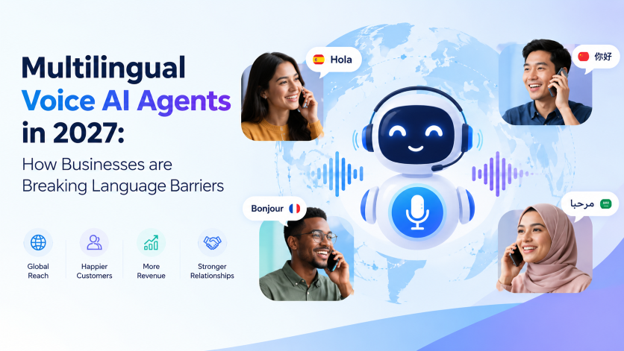
While these AI voice agent services for businesses become more and more popular, some questions arise: How accurate is the language? What safeguards are provided for the privacy of customers? Then where do the human representatives fit into automated discussion? Therefore, let’s look at how these systems are changing the dynamics of customer interactions. In this blog, you’ll understand what multilingual voice AI agents are, the challenges they encounter, including accuracy, privacy protection, and the changing role of human agents.
Where Businesses are Using Multilingual Conversational AI
- Customer service: Voice agents answer simple questions and updates orders for customers. Explain basic procedures and direct customers to the right resources.
- Sales development: Outbound agents reach out to prospects, set basic qualifying calls. Product evaluation and commercial negotiation are handled by human agents.
- Appointment management: Automate the process of setting up appointments, reminders, and reschedule with privacy & sector-specific requirements being properly followed.
- Customer feedback: Conduct surveys after service which can be filled out in the customer’s native tongue.
These applications come together, to reduce the number of repeated calls employees make. They also enable support to be available outside of working hours, if the supporting systems exist, and there are escalation procedures put in place.
Consider the following circumstances in which businesses are overcoming language barriers using multilingual artificial intelligence to voice agents. Let’s look at how businesses are breaking language barriers with multilingual AI voice agents.
How Businesses are Breaking Language Barriers with Multilingual AI Voice Agents
Enable natural conversations across languages
Multilingual AI voice agents interpret free speech and reply as per the caller’s language. These voice AI agents will be able to detect user intent and respond as they would in normal conditions, unlike IVR menus. TASR records the speech input; an NLP input library translates the meaning, and TTS provides the response. These three work well together to deliver low friction and smooth exchanges. Customers don’t wait long for answers, and businesses remain consistent in their services across languages. Additionally, businesses can roll out their enterprises to new marketplaces without establishing additional language teams.
Traditional IVRs struggle when teams have to predict caller paths. Voice agents adjust in real time. They can recognize intent in casual speech and manage regional accents even during mid‑call when language changes. All this without disrupting the conversation. This adaptability reduces churn and strengthens customer experience. It has benefits for companies aiming at new target markets and in this way helps to keep quality of service.
Automate Salesforce workflows seamlessly
The Multilingual AI voice agents can receive access to authorized records, update lead status, and set meetings up with Salesforce integration. Outbound campaigns and follow‑ups are recorded automatically, reducing admin efforts and speeding up cycles. Make note that accuracy depends on the quality of CRM data and workflow design, so use strict controls and review processes.
Ensure Sales outreach and lead qualification
Multilingual voice AI agents augment sales development by connecting with customers, clarifying needs, and enabling the qualification of potential customers. They book appointments, and in the course necessary, discuss negotiation-related matters with human agents. The integrated notes and status updates provide sales reps with the right context at transfer time. This frees your team from going back and forth discussing things. In addition, prospects are engaged in their own language in a timely manner.
Extend customer service out of business hours
Salesforce AI voice Agent gives around the clock assistance. These can respond to questions and update orders and help customers complete simple tasks. They are also responsible for bookings and rescheduling in various industries, such as health services or finance. Allows services outside working hours and escalation paths to complex issues, thru routine automation. The customers derive reliable support in their preferred language irrespective of the time zone they are in.
Safeguarding privacy as it scales globally
Data protection is required. Voice Agents must follow Consent, Recording, Retention and Access policies (Jurisdictional). The outputs are to be monitored carefully and the team to be allowed to check the outputs. Having appropriate levels of privacy protocols makes the difference between a confident customer base or not. If your business operates in a regulated industry, then the importance of compliance frameworks cannot be taken lightly.
Readiness Checklist for Multilingual Voice AI Agents Deployment
- Reliability: Make sure your system is compatible with CRM and other third-party systems to operate.
- Data safety: Apply consent, recording, retention, and access policies that meet regulatory standards.
- Human oversight: It’s always advisable to have a set of guidelines that will inform when to pass the call over to a human agent, and what should from person to person be shared with that agent.
- Linguistic accuracy: Verify quality of the speech with both native and non‑native speakers having diverse accents, dialects, and common expressions.
- Operational performance: Monitor operational aspects of the system including mistake in recognition, customer feedback and call abandonment rates, and rate of human intervention with the system; resolution rate.
- Response latency: Measure how quickly the agent replies, even when interrupted.
- Cost: Businesses thinking about implementing AI voice agent services for businesses will also need to consider language specific testing and continuous upkeep and integration expenses. Time allocated to review the system’s performance is also part of the budget.
Multilingual Voice AI Agents in 2027: What’s Next
Multilingual conversational AI is reshaping how companies engage with customers across languages. Therefore, as we witness advancement in LLMs and speech synthesis, these support conversations will go beyond simple Q&A. Although performance still differs across languages, since the biggest challenge or gap is with training data being limited for now. But this isn’t changing the fact that Salesforce AI voice Agent offers businesses scalable options for cross‑language communication. Ensure for higher adoption you have high-quality data, proper CRM integration, and privacy safeguards to offer compliant and safe communication.